
Singapore has spent decades demonstrating that dense urbanisation and nature can coexist harmoniously. Its current ‘City in Nature’ vision is taking this philosophy further, with the National Parks Board targeting 200 hectares of skyrise greenery by 2030 while continuing to restore nature within the urban landscape. Yet as biophilic thinking moves from city planning into offices, commercial environments and everyday interiors, a practical challenge remains: greenery must compete for space, require minimal intervention and remain healthy long after installation.
It is within this gap that Living Products is building its proposition. Rather than treating plants as decorative additions placed in vacant corners, the Singapore-based company approaches greenery as an architectural element. Through modular, plug-and-play biophilic solutions, it seeks to make living greenery easier to design, install and maintain within contemporary spaces. Its philosophy is succinct: ‘Biophilic greenery curated with ease of mind.’
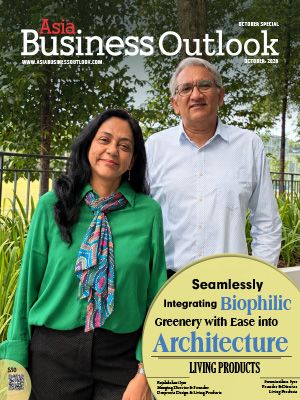
The company’s approach is strengthened by its partnership with DEEPROOTS DESIGN, a landscape architecture practice with nearly three decades of experience. Together, the two bring industrial design, landscape architecture, horticultural knowledge and biophilic thinking into a common framework. At the centre of Living Products is its Founder and Director, Swaminathan Iyer, who brings extensive industrial design expertise, including design education at the Industrial Design Centre (IDC), IIT Bombay, as well as the University of Art and Design Helsinki, now part of Aalto University.
Working alongside; DEEPROOTS DESIGN Founder and Living Products Manging Director and Founder Raji (Rajalakshmi Iyer), a landscape architect and alumna of the School of Planning and Architecture, New Delhi, with close to 28 years of experience, the partnership combines product thinking with a deep understanding of plants to create nature positive spaces indoors and outdoors. Both the founders call themselves as ‘NATURE CONNECTORS’ and are on a mission of connecting people to nature positive spaces through humane designs.
Moving Greenery from Afterthought to Architecture
The idea behind Living Products emerged from a simple observation: people value nature, but traditional ways of introducing greenery indoors often bring practical and technical challenges. Conventional systems can involve concerns around water leakage, structural weight, soil-related pests and high-intensity maintenance. Without thoughtful planning, what begins as a green vision can consequently become a technical and maintenance liability.
The gap became particularly evident as DEEPROOTS DESIGN expanded from exterior landscapes into interior landscaping. On projects where completed interiors had to be greened without readily available water or power provisions, the team found that the market offered limited alternatives. When traditional greenery systems have not been considered during the original interior planning, introducing them later can require additional provisions for water, drainage and power, making implementation complicated. Living Products was conceived specifically to overcome these constraints.
Its solutions are designed as modular architectural greenery systems that can be incorporated without necessarily breaking walls, creating elaborate pipelines or substantially modifying finished interiors. This changes the role greenery can play. Instead of placing a pot wherever space remains, plants can become partitions between workstations, form vertical compositions or occupy architectural surfaces that conventional planters cannot easily address.
Modularity also allows plants and components to be changed with relative ease, enabling users and designers to introduce seasonal variations, refresh compositions and bring greater vibrancy and transformation to a space over time. Components can also be moved and reconfigured as spatial requirements evolve.
For Living Products, this distinction is fundamental. The company is not attempting to create another planter; it is working to establish a category in which greenery is considered alongside architecture rather than after architecture. They are breaking the box and creating a niche with a unique approach.
Designing Around the People Who Use, Install & Maintain
Behind Living Products’ product development is a deceptively simple framework built around three stakeholders: the designer who conceives the environment, the team that installs it and the person responsible for maintaining it.
For architects and interior designers, the system must provide enough flexibility to create different outcomes rather than dictate a standard composition. Living Products therefore positions its modules much like a design tool - the underlying system remains consistent, but designers retain the freedom to determine how it is expressed within a project.
Installation presents the second challenge. Urban interiors are frequently operational or substantially completed by the time greenery is introduced. Products therefore need to minimize disruption and simplify execution.
Maintenance completes the equation. Water leakage, floor stains, drainage, difficult plant replacement and ongoing upkeep can quickly undermine an otherwise attractive installation. Living Products designs around these pain points, recognizing that a biophilic environment succeeds only when the greenery remains viable over time.
The approach also responds to what the company identifies as ‘time poverty’. Urban users may appreciate plants without having sufficient time to manage complicated maintenance routines. Making nature easier to live with is therefore central to increasing its adoption.
The idea behind Living Products emerged from a simple observation: people value nature, but conventional ways of introducing it indoors often create practical difficulties that keeps people away from connecting to nature
Where Product Engineering Meets Landscape Intelligence
A modular system alone cannot guarantee successful greenery because every installation ultimately involves a living organism. Plant species respond differently to light, air-conditioning, humidity, water and growing media. Their foliage, form, colour and growth characteristics also affect the visual language of a space.
“This is where the relationship with DEEPROOTS DESIGN adds another dimension. The landscape practice brings horticultural and spatial expertise, while Living Products contributes industrial design and product engineering.
Together, the two can evaluate not simply where greenery looks attractive, but where particular plants can realistically survive and perform”, says Rajalakshmi Iyer, Manging Director and Founder, Deeproots Design and Living Products.
DEEPROOTS DESIGN’s experience spans projects from smaller spaces to large campuses and developments, with work associated with organizations including Microsoft, Bagmane for Google, Infosys, TCS, ITC and Taj. Its move into interior landscaping created the practical foundation from which Living Products’ product innovation emerged.
The collaboration also enables customized solutions. Projects begin by understanding the site, client aspirations, surrounding context, user requirements and, where relevant, corporate brand standards.
Concepts are then developed around spatial storytelling before being refined against budgets, timelines, installation requirements and maintenance realities.
This combination is particularly relevant as Singapore pushes nature deeper into its built environment. NParks itself describes biophilic design as applicable across scales - from indoor and corridor planting to sky gardens and larger urban landscapes - reinforcing the growing need for greenery that can work within increasingly dense environments.
Sustaining Greenery, Not Merely Installing It
For Living Products, sustainability begins with longevity - ensuring that biophilic greenery can continue to thrive rather than merely looking impressive at the point of installation. It also extends to responsible material selection and the responsible use of water as a resource.
An installation that appears lush at handover but deteriorates because it is difficult to maintain does little to advance biophilic design. The company therefore considers longevity, maintenance and responsible resource use alongside aesthetics.
Its product philosophy explores ways to reduce dependence on conventional soil, manage water more efficiently and develop materials and systems suited to longer-term use. Living Products has also secured GreenPro certification for its products, while DEEPROOTS DESIGN’s India office is IGBC Gold certified.
The broader ambition extends into wellness. Both partners believe the next phase of design must address not only environmental ecology but what they describe as the ‘ecology of the mind.’ As technology occupies more of everyday life, environments that encourage calmness, sensory engagement and interaction with living systems will assume greater importance. This will help in rooting the user and provide a sense of being with empathy and humaneness at the core.
“That thinking also explains why the partnership looks beyond plants as visual objects. Bird-friendly environments, native planting, water elements and spaces that allow closer interaction with foliage can help make nature something people experience rather than merely observe”, adds Swaminathan Iyer, Founder and Director, Living Products.
Taking a Modular Biophilic Vision to Global Markets
Living Products has already installed more than 10,000 units, an important milestone for a business operating within a specialized and still-emerging product category. Repeat customers have been particularly significant, offering practical validation that ease of maintenance and usability matter alongside design.
The road ahead, however, involves changing established habits. Greenery is still frequently introduced after architectural and interior decisions have been made. Living Products wants to shift that conversation upstream, encouraging architects, developers and organizations to consider nature during the initial design process.
“Our next phase will also focus on expanding across global markets and collaborating with like-minded designers, businesses and partners. As urban homes and workplaces become denser, the company sees modularity, customization, ease of installation and low-maintenance design becoming increasingly relevant”, mentions Rajalakshmi Iyer.
Ultimately, Living Products’ ambition is larger than finding new places for plants. It is working toward environments where nature no longer has to fight for leftover space. By combining industrial design with landscape intelligence, the company is seeking to make greenery a practical, enduring and effortless part of architecture - bringing the idea of living among nature closer to the everyday urban e xperience.
We use cookies to ensure you get the best experience on our website. Read more...



.jpg "Technology in Cancer Care: A story of evolving paradigms")
.jpg "Bringing Shop Floor to Manufacturer's palm: Smart Factory Solutions for tomorrow")