Pediatric ophthalmology remains one of the most vital yet under-recognized components of India’s healthcare system. An estimated 1.4 million children in the country live with blindness, and many more experience visual impairment that is preventable or treatable if detected early.
Despite growing awareness, the specialty continues to face gaps in structured training, public education, and access to dedicated child-focused care.
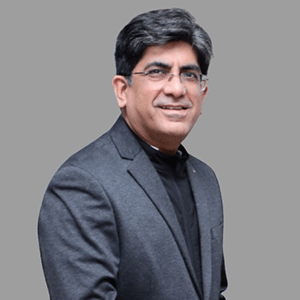
It is within this landscape that Dr Jitendra Jethani has spent more than two decades building a practice rooted not only in surgical precision but in patience, perspective, and long-term responsibility.
A pediatric ophthalmologist trained in the early 2000s, he returned to Gujarat at a time when children with eye conditions were often managed within adult systems. Care was available, but it was not always designed around the unique developmental needs of a child.
Understanding That Children Are Not Small Adults
Early in his career, Dr Jitendra recognized that pediatric ophthalmology demands more than technical expertise. A child entering a clinic does so with uncertainty, fear, and limited understanding. Parents arrive carrying anxiety, confusion, and often guilt. In such an environment, clinical competence alone is insufficient.
Pediatric care requires time, time to explain, reassure, and build trust. It requires translating complex diagnoses into language that families can understand. Most importantly, it requires recognizing that treatment decisions are made by adults, but their consequences shape a child’s entire future.
This philosophy became the foundation of Baroda Children’s Eye Care and Squint Clinic, a center dedicated exclusively to pediatric eye conditions and adult strabismus cases that were missed in childhood.
The clinic was built on a simple principle: pediatric ophthalmology is not a collection of isolated problems. Squint, amblyopia, refractive errors, cataracts, and retinal conditions frequently overlap. Missing one component can compromise the entire visual outcome.
A Comprehensive Model of Care
The clinic integrates pediatric cataract management, strabismus surgery, amblyopia therapy, refractive services, myopia control, ocular allergy management, orthoptic services, and screening for retinopathy of prematurity. This comprehensive approach reflects a deeper understanding of visual development: children’s vision matures through use.
If one eye is neglected early, the brain adapts in ways that may not fully reverse later.
Early diagnosis is critical, but sustained follow-up is equally important. Glasses only work when worn consistently. Patching only succeeds when parents remain committed. Long-term monitoring only matters when families understand its purpose.
Dr Jitendra emphasizes parental involvement as central to pediatric success. “Children do not make treatment decisions — adults do,” he often reminds families. When parents understand the reasoning behind therapy, compliance improves. When doubt remains, treatment falters.
Measuring Success Over Years, Not Days
In pediatric ophthalmology, outcomes cannot be judged at discharge. The true measure of success unfolds over years. A child once struggling to see clearly becomes a confident student. A squint corrected at the right time prevents amblyopia and improves social confidence. Some former patients now return as parents, bringing their own children for care, a quiet testament to continuity and trust.
Technology has enhanced diagnostic accuracy and surgical precision, but it has not replaced clinical judgment. Most instruments are adapted from adult care and must be interpreted with an understanding of childhood variability.
Age, cooperation, and developmental stage all influence examination findings. In pediatric ophthalmology, numbers are important, but context is everything.
In pediatric ophthalmology, 27 success is not measured at discharge. It reveals itself years later, when a child who once struggled to see grows into a confident adult
Beyond the Clinic: Training and Awareness
Dr Jitendra also recognizes broader systemic challenges. Pediatric ophthalmology remains underemphasized in postgraduate medical training. Many young ophthalmologists complete their education without meaningful exposure to the specialty as a distinct discipline.
In a country with a large pediatric population and rising concerns such as childhood myopia, this gap is significant.
Public awareness presents another challenge. Families frequently report that they were unaware a squint could be corrected early, or that untreated amblyopia might become permanent. Delayed diagnosis remains common, not because treatment is unavailable, but because recognition is late. “Teachers, pediatricians, and parents all share responsibility in early detection,” he notes. “Without that shared awareness, preventable visual impairment continues quietly.”
The Long View
The future of pediatric eye care in India will depend not on dramatic breakthroughs alone, but on consistent fundamentals: better training, structured child-focused services, evidence-based practice tailored to Indian populations, and clear communication with families. Above all, it requires recognizing children not as small adults, but as individuals whose visual systems and futures, are still developing.
For Dr Jitendra Jethani, the guiding philosophy remains steady: treat the child today, and you shape decades of life ahead. The work is measured not in immediate outcomes, but in the quiet confidence of a young adult who once struggled to see and now moves through the world without limitation.
Dr Jitendra Jethani, Pediatric Ophthalmologist
Dr Jitendra Jethani is a pediatric ophthalmologist with over two decades of experience in managing childhood eye disorders. Based in Gujarat, he focuses on early diagnosis, comprehensive treatment, and long-term follow-up of pediatric conditions including strabismus, amblyopia, refractive errors, pediatric cataract, and myopia control. He founded Baroda Children’s Eye Care and Squint Clinic to create a dedicated child-centered model of ophthalmic care and continues to advocate for greater awareness and structured training in pediatric ophthalmology across India.
We use cookies to ensure you get the best experience on our website. Read more...



.jpg "Technology in Cancer Care: A story of evolving paradigms")
.jpg "Bringing Shop Floor to Manufacturer's palm: Smart Factory Solutions for tomorrow")