Emission testing in India is closely associated with regulation, public health, and responsibility. As the pollution norms became stricter over time, particularly with BS3 eventually being replaced by BS6 standards, the need for accurate and reliable testing became inevitable. What used to be a compliance formality has become a system that determines environmental outcomes. With governments pushing for cleaner air and better data, emission testing devices have ceased to be on the periphery of the air quality discussion in India.
It was within this evolving landscape that Indus Scientific Private Limited took shape. The company was established back in 1996 when India was entirely relying on imported PUC (Pollution Under Control) testing machines. It was founded by a visionary nuclear chemist and a former Director at the Indira Gandhi Centre for Atomic Research Dr C. K. Mathews, who believed that scientific equipment critical to public welfare should be built within the country.
After retiring from the Department of Atomic Energy, he chose not to step away from work, instead used his experience to develop indigenous emission testing solutions. The move formed the basis of Indus Scientific, which presented the first ever locally produced smoke meter and gas analyzer for vehicle emissions testing in India.
Refining the Mechanics of Emission Testing
Anil Mathews, Managing Director at Indus Scientific says, “Since the inception of the company, we have focused on equipment used at the ground level of regulation. Our core products include smoke meters for diesel engines and gas analyzers for petrol and CNG vehicles, both widely used at PUC centers.” These instruments have been modernized over time to keep up with any significant change in emission standards, creating continuity rather than disruption for users.
In addition to vehicle testing, the company developed flue gas analyzers for industrial chimneys, which are used by manufacturing units to determine whether their emissions are within the prescribed levels. Products for measuring oxygen levels in furnaces further extended their presence into industrial processes tied to combustion efficiency.
The differentiating factor for Indus Scientific is not scale or visibility, but its consistent focus on how testing is actually carried out.
It was one of the first in its segment to launch folded geometry smoke meters, mobile based remotes and OBD-based measurements. These were not technology upgrades for their own sake, but answers to actual gaps in accuracy and usability. “With the increasing number of software-driven vehicles, Indus Scientific has integrated onboard diagnostics into its machines, allowing original engine data to be captured without adding redundant sensors,” signifies Anil.
To date, service has been a fundamental requirement. The company did not just depend on physical repairs, instead built its own electronic circuits that enabled machines to be monitored remotely. Engineers can diagnose faults by accessing internal components virtually, reducing downtime and unnecessary shipping. What started as a wired remote has since been developed into mobile-based operations where the technicians can conduct tests using smartphones. Such changes are a silent transition into making compliance easier without diluting its seriousness.
Staying Consistent in a Changing Sector
Over nearly three decades, Indus Scientific has grown from a two-person operation into a structured organization with dedicated teams across manufacturing, research, quality, customer service, sales, and administration. While the founder passed away last year, the systems he helped build continue to guide the company’s approach. Department heads operate with independence, but also with an understanding of how closely their work affects regulatory outcomes on the ground.
The company’s long presence in the sector has also exposed it to persistent challenges. One of the most pressing is the spread of uncertified and counterfeit testing machines. These not only undermine genuine manufacturers, but also weaken the credibility of emission testing itself. By supplying only certified equipment and aligning closely with regulators, Indus Scientific has chosen a slower, steadier path. Its continued inclusion in the ARAI-approved list of manufacturers since 1996 reflects that stance more than any formal award.
With the increasing number of software-driven vehicles, we have integrated onboard diagnostics into our machines, allowing original engine data to be captured without adding redundant sensors
Working Within a Shifting Landscape
Looking ahead, the company remains focused on change rather than expansion for its own sake. New emission norms, greater networking of testing centers, and the gradual shift toward electric vehicles are reshaping the sector. Work is already underway on an ambient air quality monitoring system that measures multiple environmental parameters, currently awaiting certification. There is also early exploration into how safety and diagnostic tools might evolve for electric mobility.
In a field where credibility matters more than claims, Indus Scientific has built its relevance through persistence. Its work sits quietly behind compliance certificates and test reports, rarely noticed, yet essential. “As India continues to debate air quality and accountability, our journey offers a reminder that long-term impact often comes from staying close to the problem and even closer to the solution, Anil concludes.
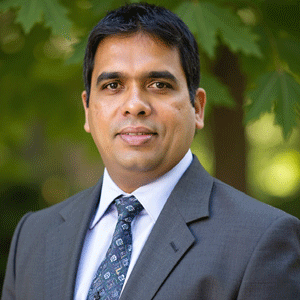
Anil Mathews, Managing Director, Indus Scientific Pvt. Ltd
Anil Mathews is a Managing Director at Indus Scientific Pvt. Ltd. and a seasoned transformation leader with over 30 years of experience across manufacturing and services. An ISB Hyderabad MBA and Mechanical Engineer, he brings deep expertise in Lean, Six Sigma, BPM, and change management. Formerly General Manager and Senior Practice Partner at Wipro Consulting, he has led large-scale operational improvement and cost-reduction initiatives across diverse industries.
We use cookies to ensure you get the best experience on our website. Read more...
.jpg "Ray Nano Science & Research Centre: Bringing the Second Green Revolution Through Nano Technology")
.jpg "Technology in Cancer Care: A story of evolving paradigms")
.jpg "Bringing Shop Floor to Manufacturer's palm: Smart Factory Solutions for tomorrow")