The energy industry of Southeast Asia stands at a crossroads. Electricity demand is climbing, decarbonisation targets are tightening, and power-hungry industries such as data centres are reshaping the load profile of entire grids.
Against this backdrop, large consumers and utility companies face a harder question than ever before: how do you secure energy that is reliable, scalable, and clean, while navigating policy uncertainty, grid constraints, and the relentless pressure of long-term cost efficiency? Traditional power models, built around centralised generation and fossil fuels, are increasingly ill-equipped for a landscape that demands flexibility, resilience, and sustainability in equal measure.
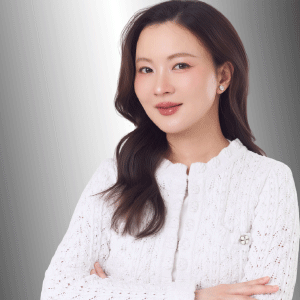
It is precisely this complexity that Gunkul Engineering has positioned itself to address. Under the leadership of CEO Naruechon Dhumrongpiyawut, the company has evolved into a full-spectrum energy partner, offering end-to-end services that span manufacturing, engineering and construction, renewable power generation, and advanced energy management.
The result is an organisation that does not merely supply power, but helps businesses across Asia transition to energy systems that are inclusive, dependable, and built for the long term.
Redefining Energy for High-Growth Economies
Gunkul’s service portfolio begins where most energy companies end at the hardware level. The company designs and manufactures medium- to high-voltage electrical equipment essential for substations, transmission systems, and grid connections.
This vertical integration is not incidental; it gives Gunkul direct control over quality, cost, and delivery timelines, advantages that compound when the same equipment feeds directly into its own infrastructure and EPC projects.
That engineering and construction capability extends to utility-scale and distributed renewable energy projects, solar farms, substations, and transmission infrastructure designed to navigate the regulatory complexity and grid integration challenges that define Southeast Asian energy markets. Today, renewable energy anchors Gunkul’s core business, supported by the second-largest renewable portfolio in Thailand and a growing solar footprint across Vietnam, Malaysia, and Japan.
Beyond generation, the company is expanding into energy-as-a-solution services, helping industrial and commercial clients design, deploy, and manage clean power systems matched to their operational needs. Underpinning all of this is EMERGE, Gunkul’s proprietary digital energy management platform, which enables real-time monitoring, performance optimisation, and regulatory-compliant energy planning. Tailored to Thailand’s tariff structures and policy frameworks, EMERGE scales from household installations to large-scale factories, and is already preparing clients for emerging market structures such as direct power purchase agreements and peer-to-peer energy trading.
“Our role is no longer just to generate power, but to stand beside our customers as a long-term energy partner. We create value by integrating engineering, infrastructure, and digital intelligence to solve real energy challenges,” says Naruechon Dhumrongpiyawut, CEO, Gunkul Engineering.
From Power Infrastructure Roots to Asia’s Green Energy Partner
Understanding how Gunkul arrived at this position requires going back more than four decades, to its origins as a trading company serving government infrastructure projects. The early focus on manufacturing medium-and high-voltage electrical equipment was a deliberate, technical bet and it laid an operational foundation that would prove essential as the company later pivoted towards renewable energy and integrated power solutions.
Naruechon’s own trajectory within Gunkul mirrors that evolution. A second-generation leader who describes herself as an operator by nature, she began her career within the organisation working directly on project development. A formative chapter came when she led Gunkul’s first overseas renewable energy investment, in Japan, an experience she credits with shaping her understanding of cross-border complexity and long-term value creation. She went on to serve as Chief Operating Officer of the energy segment, where she played a central role in growing the renewable portfolio from approximately 600 MW to around 1,500 MW before taking on the CEO role this year.
That operational grounding is visible in how she runs the business. Rather than orienting her teams around market rankings or asset accumulation, Naruechon focuses on what she describes as solving energy challenges in a highly dynamic regulatory and technological environment. Internally, she builds for resilience through cross-functional collaboration, speed of execution, and continuous learning capabilities she sees as prerequisites, not advantages, for operating at scale in Southeast Asia’s energy markets.
Looking to 2026 and beyond, the company is targeting new business lines that align with net-zero commitments across the region, while investing in people, technology, and global capabilities. The long-term vision is both ambitious and deliberate: to make clean energy accessible not only to large corporations but to businesses, communities, and households, building an energy future that is decentralised, inclusive, and durable across Thailand and the broader Asian region.
Naruechon Dhumrongpiyawut, CEO, Gunkul Engineering
Our role is no longer just to generate power, but to stand beside our customers as a long-term energy partner. We create value by integrating engineering, infrastructure, and digital intelligence to solve real energy challenges
We use cookies to ensure you get the best experience on our website. Read more...

.jpg "Technology in Cancer Care: A story of evolving paradigms")
.jpg "Bringing Shop Floor to Manufacturer's palm: Smart Factory Solutions for tomorrow")