Global agriculture today stands at a decisive moment. Over the past six decades, the agricultural systems that emerged during the Green Revolution enabled the world to dramatically increase food production. Improved crop varieties, irrigation infrastructure and chemical fertilizers helped countries like India move from food scarcity to food security. Yet the same systems are now confronting a new challenge nutrient inefficiency.
According to the Food and Agriculture Organization (FAO), global fertilizer consumption today exceeds 190 million metric tons of nutrients annually. Nitrogen fertilizers account for nearly 60 percent of this usage. However, agronomic studies consistently show that the Nutrient Use Efficiency (NUE) of conventional fertilizers averages only 30 - 40 percent, meaning that more than half of applied nutrients are lost before plants can absorb them. This global challenge is precisely where emerging nano-fertilizer technologies are beginning to play a role.
Building a Technology Platform for Agriculture
Ray Nano Science & Research Centre, an Indian organization, has developed a technology platform focused on Nano-scale nutrient delivery systems designed to improve plant nutrient absorption. Unlike traditional fertilizer companies that largely manufacture bulk nutrients, Ray Nano has positioned itself at the intersection of advanced material science, formulation chemistry and agricultural technology development. Based in Gujarat, the company combines research & laboratory validation, product innovation & formulation development, regulatory approvals, and global collaborations & technology licensing.
This integrated approach is increasingly relevant in a sector where scientific validation and agricultural scalability must progress together. Most importantly, RAY NANO SCIENCE & RESEARCH CENTRE is the first Indian Private Sector company who has got Fertilizer Control Order license for its Nano Urea in India.
RAY NANO SCIENCE & RESEARCH CENTRE’s portfolio reflects the expanding scope of Nano-based agricultural inputs. The company has developed multiple Nano-nutrient formulations designed to deliver essential plant nutrients with improved dispersion and uptake characteristics. Its portfolio includes Nano Urea (Nano Nitrogen), Nano DAP, Nano NPK, Crop-Specific HydroGel-based Fertilizers under the PhytoGelix platform, Nano Micro Nutrients, and Nano Bio Stimulants designed to enhance plant metabolism & nutrient efficiency.
Among these innovations, one development has drawn particular attention – Granular Nano Urea, introduced by RAY NANO SCIENCE & RESEARCH CENTRE as an attempt to integrate nano-scale nutrient efficiency into the traditional granular fertilizer format used widely in agriculture.
Innovation through Nano-Carrier Technologies
According to UN Environment Programme, Emerging Technologies Report, “Innovative technologies, including Nanotechnology, have the potential to improve agricultural productivity while reducing environmental pressure”. Nanotechnology involves engineering materials at dimensions measured in Nanometers (one billionth of a meter). At this scale, particles exhibit dramatically higher surface area and different physicochemical behavior compared with conventional materials. In agriculture, this can allow nutrients to be delivered in highly dispersed forms that plants can absorb more efficiently.
Research summarized in Frontiers in Plant Science (2022) suggests that Nano-formulated nutrients have the potential to significantly improve nutrient uptake efficiency when compared with conventional fertilizers. Even modest improvements in nutrient efficiency could translate into significant reductions in fertilizer consumption globally.
Carrier technologies are increasingly recognized as a key element in Nano agriculture. Such delivery platforms determine how nutrients are released, absorbed and utilized by plants. “Nanotechnology-based delivery systems may significantly enhance the efficiency of agricultural inputs”, says the OECD Report on Nanotechnology in Food and Agriculture. Beyond nutrient formulations themselves, RAY NANO SCIENCE & RESEARCH CENTRE has focused on developing nano-carrier technologies that influence how nano-nutrients interact with plant surfaces and soil environments.
The company has introduced three proprietary Nano-carrier platforms – Phyteon, Hepceidon, and HydroGel. While Phyteon refers to an organic carbon quantum dots-based Nano carrier designed to enhance foliar and root absorption efficiency, Hepceidon corresponds to a Nano-encapsulation matrix aimed at improving the long-duration sustained availability of nutrients, and HydroGel is a moisture-responsive carrier designed to facilitate efficient nutrient delivery.
In parallel, the company is also working on converting conventional fertilizer plants into Nano-enabled facilities, a strategic approach aimed at significantly reducing capital expenditure (CapEx) while accelerating the commercialization of Nano-fertilizer technologies.
NABL-Certified Nano-Fertilizer Laboratory
A distinguishing feature of RAY NANO SCIENCE & RESEARCH CENTRE’s infrastructure is its first NABL-accredited Nano-fertilizer laboratory currently operating with 18 accredited scopes. The accreditation is issued by the National Accreditation Board for Testing and Calibration Laboratories (NABL). The laboratory supports validation and testing of nano agricultural inputs, including Nano Nitrogen, Nano DAP Nano NP, and Nano NPK. It evaluates critical parameters such as particle size measurement, stability, chemical composition and other performance characteristics. Such validation frameworks are essential because Nano-materials behave differently from conventional agricultural inputs and require rigorous testing before commercialization.
Among RAY NANO SCIENCE & RESEARCH CENTRE’s technological developments, Granular Nano Urea represents a particularly notable innovation. Most Nano fertilizers currently available globally are liquid formulations. However, granular fertilizers remain deeply embedded in agricultural supply chains and farmer practices worldwide. By integrating Nano efficiency into a granular fertilizer format, RAY NANO SCIENCE & RESEARCH CENTRE is attempting to bridge traditional fertilizer systems with emerging nano technologies. If scalable, such innovations could accelerate adoption of nano fertilizers across large agricultural markets.
Collaborations with Fertilizer Industry Stakeholders
RAY NANO SCIENCE & RESEARCH CENTRE’s technological developments have also led to collaborations with fertilizer manufacturers and industry stakeholders. The company has entered into technology licensing arrangements with major fertilizer corporations of India, accelerating the industrial-scale integration of Nano-fertilizer technologies into the country’s Nano-fertilizer production landscape. Such collaborations indicate a growing model where specialized research firms develop advanced agricultural technologies which are then integrated into larger fertilizer manufacturing networks.

As countries seek solutions to fertilizer supply volatility and environmental pressures, interest in Nano fertilizers is expanding internationally. According to the International Fertilizer Association (IFA), Latin America alone consumes more than 30 million metric tons of fertilizers annually, making efficiency-enhancing technologies highly relevant. Reflecting this interest, 11 ambassadors representing Latin American countries recently visited RAY NANO SCIENCE & RESEARCH CENTRE’s Gujarat facility to examine the company’s technologies and explore potential collaboration opportunities. The company reports engagement with stakeholders across more than 20 countries, highlighting the growing global relevance of Nano-Fertilizer technologies.
Towards a Second Green Revolution
The first Green Revolution transformed agriculture through crop genetics, irrigation and fertilizers. The next transformation may involve precision nutrient delivery, advanced materials science and improved efficiency in agricultural inputs. Many international organizations believe such technological progress will be necessary.
Ray Nano Science & Research Centre has entered into technology licensing arrangements with major Fertilizer corporations of India, accelerating the industrial-scale integration of Nano-Fertilizer technologies into the country’s Nano Fertilizer production landscape
World Economic Forum’s ‘Future of Food Report’ says emerging technologies such as nanotechnology could reshape agricultural inputs and help increase productivity while reducing environmental impact. Within this evolving technological landscape, the work being undertaken by RAY NANO SCIENCE & RESEARCH CENTRE reflects one of the most outstanding efforts to translate Nanotechnology research into practical agricultural solutions.
If such innovations achieve widespread adoption, they may contribute to what many observers are beginning to describe as the foundation of a second Green Revolution, one driven not only by yield, but by efficiency and scientific precision. And it is this emerging role in the Nano-fertilizer ecosystem that has brought RAY NANO SCIENCE & RESEARCH CENTRE into the spotlight in recent years. Siddhartha Doshi, the CEO of Ray Nano Science & Research Centre opines, “The Second Green Revolution will not be driven by more inputs, but by smarter science. At RAY NANO SCIENCE & RESEARCH CENTRE, we are working to ensure that Nanotechnology improves farmer prosperity while protecting the environment for future generations”.
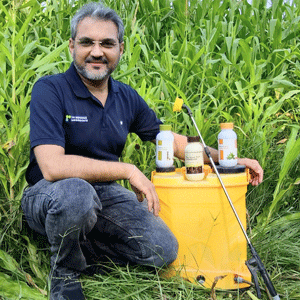
Siddhartha Doshi, CEO, Ray Nano Science & Research Centre
Nanotechnology is redefining the commercial sustainability model in agriculture by shifting the focus from volume to precision. At Ray Nano Science & Research Centre, we believe true scalability lies in delivering higher efficiency with lower environmental impact, ensuring that sustainability and profitability grow together
We use cookies to ensure you get the best experience on our website. Read more...




.jpg "Technology in Cancer Care: A story of evolving paradigms")
.jpg "Bringing Shop Floor to Manufacturer's palm: Smart Factory Solutions for tomorrow")